
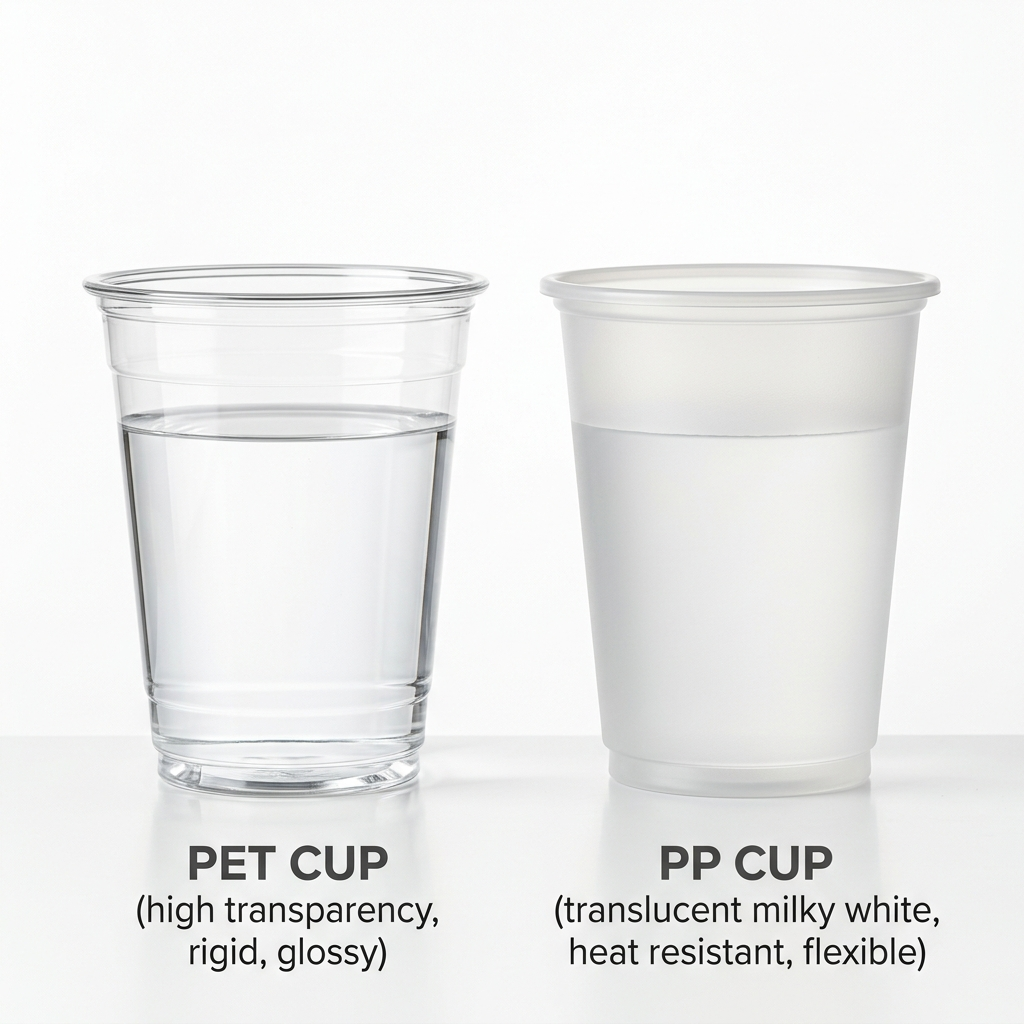
Choosing the right material for beverage cups is an important decision for cafés, bubble tea shops, juice brands, restaurants, and beverage manufacturers. PET and PP are two commonly used plastic materials, but they have different characteristics in terms of appearance, temperature resistance, rigidity, application, and recycling considerations.
Understanding these differences can help businesses select a cup that matches their beverage type, filling process, branding requirements, and target market.
In this guide, we compare PET and PP cups and explain which material may be more suitable for different beverage applications.
What Are PET and PP Cups?
What Is a PET Cup?
PET stands for polyethylene terephthalate, a polyester widely used in food and beverage packaging.
PET is known for its combination of clarity, strength, lightweight construction, and suitability for packaging applications. PET containers are widely used in food and beverage packaging, and the material is also an important part of recycling and circularity discussions.
For beverage applications, PET cups are particularly popular when product visibility is important.
Typical applications include:
Iced coffee
Milk tea
Fruit juice
Smoothies Soft drinks
Cold tea
Other chilled beverages
The transparent appearance allows customers to see the beverage, color, ice, fruit pieces, or toppings inside the cup.
What Is a PP Cup?
PP stands for polypropylene.
PP is another commonly used plastic material for food packaging. Compared with PET, PP generally offers different performance characteristics, particularly when applications involve higher temperatures.
PP cups can be used for a variety of beverage and food applications depending on the specific product design and manufacturing process.
The most appropriate material therefore depends not only on the cup itself, but also on the temperature, filling process, beverage type, lid design, and intended use.
PET vs. PP Cups: Key Differences
When selecting between PET and PP, buyers should consider more than simply the material price.
The most important factors include:
- Appearance and transparency
- Temperature requirements
- Cup rigidity and performance
- Beverage application
- Lid compatibility
- Printing and branding
- Recycling considerations
Let’s look at each factor in more detail.
Transparency and Product Visibility
One of the biggest advantages of PET cups is their high transparency.
For businesses selling colorful beverages, product visibility can be an important part of the customer experience.
For example, a clear PET cup can showcase:
- Beverage color
- Ice cubes
- Fruit pieces
- Tapioca pearls
- Jelly
- Whipped cream
- Other toppings
This makes PET particularly attractive for bubble tea, iced coffee, juice, smoothies, and other visually appealing drinks.
PP cups can also be produced in different appearances, but when maximum clarity and product visibility are important, PET is often a strong option.
Temperature Requirements
Temperature is one of the most important factors when choosing a plastic cup.
PET cups are commonly used for cold beverages and chilled applications.
For example:
PET cups are well suited to iced coffee, milk tea, juice, smoothies, soft drinks, and other cold drinks.
If the application involves hot filling or higher-temperature beverages, however, the material and specific cup construction need to be evaluated carefully.
PP is often considered when a packaging application requires greater temperature resistance.
Therefore, buyers should always confirm the manufacturer’s recommended temperature range for the specific cup model, rather than choosing a material based only on its general characteristics.
Rigidity and Cup Performance
Cup thickness and design are just as important as the material itself.
Two cups made from the same material can have different performance characteristics because of:
- Wall thickness
- Cup geometry
- Bottom design
- Rim structure
- Manufacturing process
- Overall cup dimensions
For example, a larger cup may require a different wall thickness or structural design than a smaller cup.
For commercial beverage packaging, buyers should evaluate the actual sample rather than relying only on the material name.
A good sample evaluation should include:
- Cup rigidity
- Rim strength
- Bottom stability
- Transparency
- Dimensional accuracy
- Lid fit
- Overall appearance
Choosing the Right Cup for Different Beverages
Different beverages have different packaging requirements.
Iced Coffee
For iced coffee, PET cups can be a strong choice when clear product presentation is important.
The transparent cup allows customers to see the coffee, milk, ice, and layered appearance of the beverage.
Bubble Tea and Milk Tea
PET cups are widely suitable for cold milk tea and bubble tea applications where customers want to see the beverage and toppings.
Cup diameter is particularly important because the correct lid must match the cup opening.
Juice and Smoothies
Clear PET cups can provide strong visual presentation for colorful juices and smoothies.
For brands that emphasize fresh ingredients and attractive beverage presentation, transparency can become part of the packaging design.
Hot Beverages
For hot beverages, buyers should not automatically choose PET simply because the cup is transparent.
The beverage temperature, filling method, storage conditions, and intended use must be evaluated first. Depending on the application, another material or a specifically designed cup may be more appropriate.
Lid Compatibility Matters
Choosing a cup and choosing a lid should be treated as one packaging system.
A cup may have the correct capacity but still be unsuitable if the lid does not fit securely.
Important dimensions include:
- Top diameter
- Cup opening
- Rim design
- Lid diameter
- Lid type
- Sealing or fitting structure
Before placing a bulk order, buyers should test the actual cup and lid combination.
For example, a PET cup designed for a flat lid may not be compatible with a dome lid designed for another rim diameter.
Always confirm cup-and-lid compatibility using actual samples before mass production.
Branding and Custom Printing
Packaging is also an important part of brand communication.
Depending on the cup material and production method, customized printing may be available for:
- Company logos
- Brand names
- Product information
- Promotional graphics
- Custom colors
- Seasonal designs
However, printing requirements should be confirmed according to the specific material, cup design, printing area, artwork, and order quantity.
For custom projects, vector artwork such as AI, EPS, or production-ready PDF files is generally preferred.
Sustainability and Recycling Considerations
Sustainability is becoming increasingly important in packaging purchasing decisions.
PET has an established recycling stream in many markets, although the actual recycling outcome depends on local collection, sorting, and recycling infrastructure. PETCORE Europe describes PET as an important material within food packaging and circularity, while also emphasizing the importance of appropriate design and recycling systems.
It is also important to look beyond the main cup material.
Components such as:
- Lids
- Labels
- Sleeves
- Adhesives
- Inks
- Other attached materials
can affect the overall recyclability of packaging. PETCORE Europe specifically notes that labels and sleeves need to be compatible with recycling processes to support better circularity.
Therefore, a more complete sustainability evaluation should consider the entire packaging system, not just the material printed on the product specification sheet.
PET vs. PP Cups: Comparison Table
| Feature | PET Cups | PP Cups |
|---|---|---|
| Transparency | Excellent | Good, depending on design |
| Cold beverages | Excellent | Suitable |
| Product visibility | Excellent | Depends on cup design |
| Temperature resistance | More limited for high-temperature applications | Generally better suited to higher temperatures |
| Bubble tea | Excellent | Suitable |
| Iced coffee | Excellent | Suitable |
| Juice & smoothies | Excellent | Suitable |
| Hot beverage applications | Usually not the first choice | Can be considered depending on design |
| Custom printing | Available depending on product | Available depending on product |
| Recycling | Established recycling infrastructure in many markets | Depends strongly on local recycling systems |
| Best known advantage | Clarity and presentation | Versatility and temperature performance |
Important: Actual performance depends on the specific cup design, material grade, thickness, manufacturing process, and intended application. Always confirm specifications with the supplier before bulk production.
How to Choose Between PET and PP Cups
There is no single material that is best for every beverage business.
A simple decision process is:
Choose PET when:
- You mainly serve cold beverages.
- Product visibility is important.
- You want a clear cup.
- Your drinks contain attractive colors, fruit, ice, or toppings.
- You want the packaging to contribute to product presentation.
Consider PP when:
- Your application requires greater temperature resistance.
- Transparency is less important.
- The product design is better suited to PP.
- Your packaging process requires specific PP performance characteristics.
The final decision should always be based on the actual beverage, temperature, filling process, cup design, lid requirements, and destination market.
What Should You Check Before Placing a Bulk Order?
Before confirming a large packaging order, we recommend checking at least these specifications:
1. Cup capacity
For example:
- 12 oz
- 16 oz
- 20 oz
- 24 oz
The actual usable capacity should be confirmed with the supplier.
2. Top diameter
This determines which lids may be compatible with the cup.
3. Material
Confirm whether the product is PET, PP, PLA, paper, or another specified material.
4. Wall thickness
Wall thickness can affect rigidity, appearance, and overall product performance.
5. Lid compatibility
Always test the actual cup and lid together.
6. Printing requirements
Confirm:
- Printing area
- Number of colors
- Artwork format
- Printing method
- Minimum order quantity
7. Packaging method
Confirm:
- Quantity per bag
- Quantity per carton
- Carton dimensions
- Gross weight
- Net weight
This information is also important for calculating shipping costs.
Final Thoughts
Choosing between PET and PP cups is not simply a question of which material is better.
The right choice depends on the beverage application, temperature, appearance, structural requirements, lid compatibility, branding needs, and destination market.
For businesses focused on cold beverages and strong product visibility, PET cups can offer an attractive combination of clarity, lightweight packaging, and practical performance.
For applications requiring different temperature or performance characteristics, PP may be a more suitable option.
The best approach is to evaluate the complete packaging solution rather than selecting a material based on price alone.
Looking for the right beverage cup for your product? Contact our team to discuss your required size, material, capacity, lid, quantity, and customization requirements.